Success Rates at No. 1 Fertility
At No. 1 Fertility, we are proud to be leaders in delivering exceptional IVF outcomes, We fully support greater transparency so patients can make informed choices about in vitro fertilisation and fertility treatment options.

Understanding our results
IVF success rates matter but only in context
When comparing fertility clinics, published success rates are a natural starting point. But a single percentage rarely tells the full story. Understanding what those numbers do and don’t capture is essential to making the right decision for your situation.
Why numbers vary
Not all success rates are directly comparable
Two clinics can publish very different outcomes while maintaining equally high standards of care. The difference usually comes down to patient selection and clinical philosophy.
Clinics that predominantly treat younger, first-time patients with straightforward presentations will naturally report higher averages. Clinics that accept more complex cases such as patients who have had previous unsuccessful treatment, atypical presentations, or lower-prognosis profiles, will see those numbers reflect that broader scope of care.
The Australian and New Zealand Society of Reproductive Endocrinology and Infertility (ANZSREI) Executive recommends that consumers do not use published success rates to compare clinics. The ANZSREI Executive notes that results are heavily influenced by patient and clinic characteristics that differ substantially between clinics, including patient mix, use of donor treatment, genetic testing protocols, and individual clinical decision-making. None of these are standardised across clinics.
ANZSREI is also concerned that publication of this data creates disadvantage for patients with a reduced chance of success, as clinics may be reluctant to treat such patients in order to protect their reported rates.
Source: ANZSREI Executive, Response to YourIVFsuccess website https://anzsrei.com/response-to-your-ivf-success-website/
We encourage patients to explore independent data on the Your IVF Success website as a starting point, with these limitations in mind.
Why the same rate can mean very different things
ANZSREI outlines several specific scenarios where published rates between two equally good clinics can appear very different. These are not hypothetical, they reflect real differences in how clinics operate.
Hover or click the cards to see more information.
prior treatment
decision-making
Our data
Real patients, real results
Our success rates are based on validated data submitted annually to ANZARD and independently audited as part of our accreditation process. We report across a full five-year period, currently 2019 to 2023, rather than selecting timeframes or patient subsets to present a stronger figure.
This means our data reflects real clinical practice, including patients with complex histories, prior unsuccessful cycles, and a wide range of presentations. We do not design treatment to improve statistics. We design it to improve outcomes.
Choosing a clinic
A more meaningful framework for comparison
ANZSREI recommends that patients consider the following when evaluating their options, rather than relying on published rates alone:
|
|
|
|
|
You can search for CREI-qualified fertility specialists via the ANZSREI website.
Our Success Rates
Genetic Testing
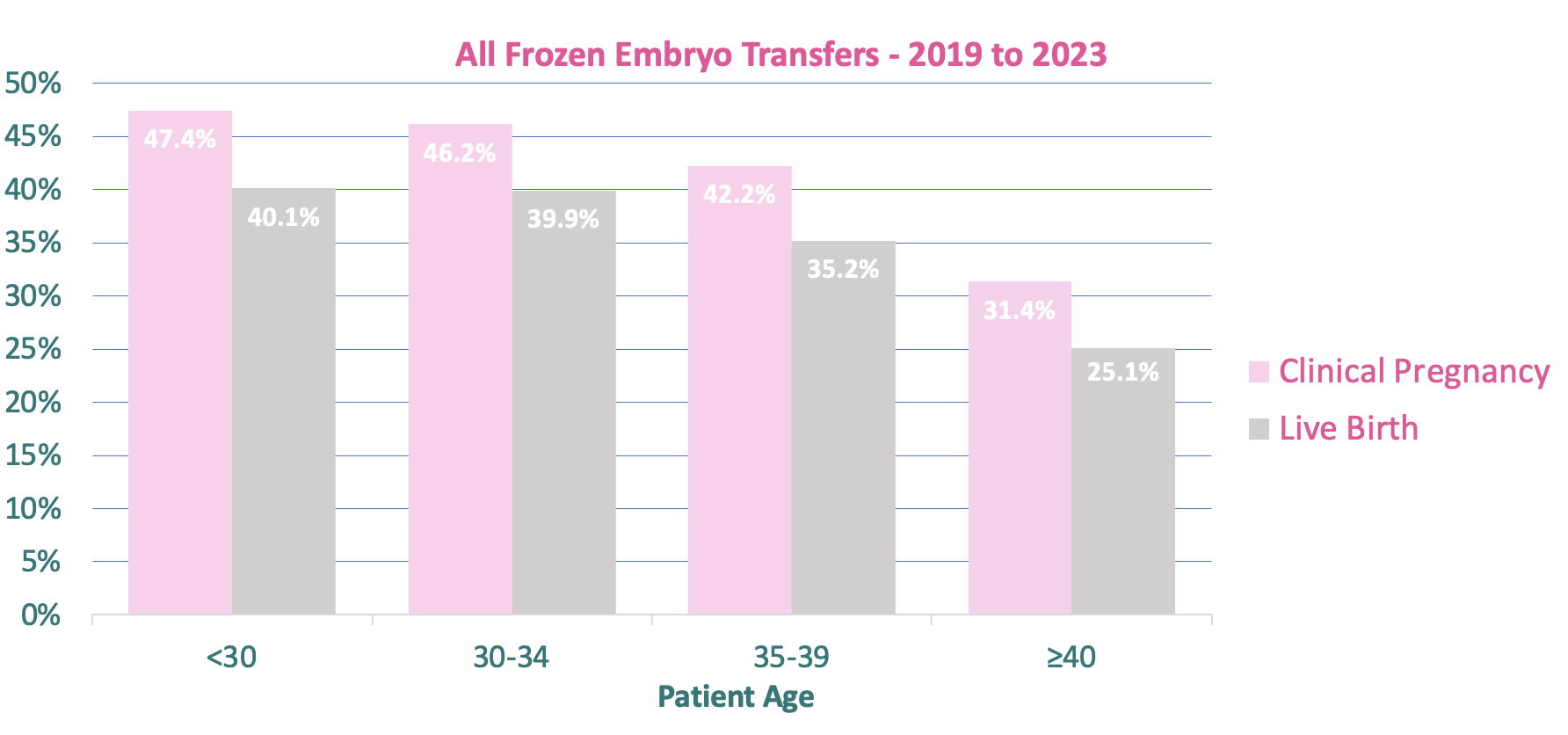
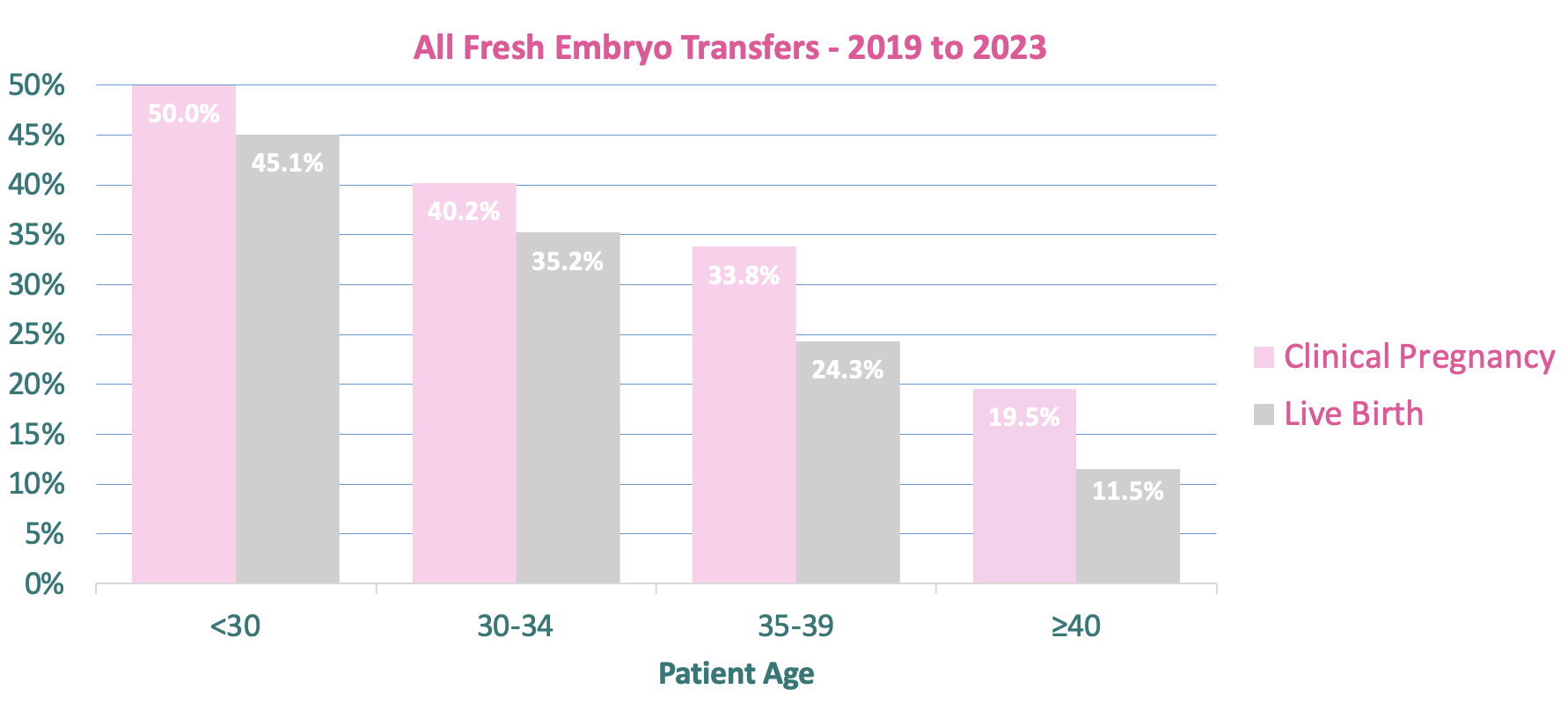
We are committed to transparency and sharing the full picture of our outcomes, including insights from genetic testing of embryos. Below are two key areas of data from No.1 Fertility, based on ANZARD submissions and internal records. These results are also linked from our Genetics pages for more detail.
Frozen Embryo Transfers with or without PGT testing
This chart shows pregnancy and live birth rates per embryo transferred for all No.1 Fertility patients from 2019–2023.
It highlights that while overall pregnancy rates per transfer tend to decline with age, the pregnancy rate remains consistent when a Euploid embryo is transferred, regardless of age.
Important notes:
- The chance of achieving a euploid embryo is lower in older patients. This data does not include patients who did not reach transfer when attempting preimplantation genetic testing (PGT).
- Data is based on all transfers in the last 5 reporting years, those performed from 2019-2023.

Low ‘No Result’ Rate
This chart highlights our outstanding “no result” rate for genetic testing. When performing embryo genetic testing there is always a risk of receiving “No Result” (more information on this can be found on our Genetics page here). A low “No Result” rate means more patients receive meaningful information about their embryos.
Key details:
• Data includes all embryos biopsied at No.1 Fertility in 2025 (n=1981).
• Comparisons are shown with large datasets from external PGT providers (22,833 and 136,252 samples).

To learn more about Number 1 Fertility’s guide to understanding success rates click here.
References:
*Lynch, C.A. et al. Examination of Inter Centre Variation in PGT-A “No Result Rate” and Efficacy of Re-Biopsy – Analysis of 22,833 Samples 2015–2019. ASRM Annual Meeting 2021. Fertility & Sterility Vol. 116, Issue 3, e395, Supplement, September 2021.
*Barrett, F. et al. Evaluation of No-Call Etiologies in Preimplantation Genetic Testing for Aneuploidy (PGT-A): Influence on Genetic and Clinical Outcomes Following Rebiopsy. ASRM Annual Meeting 2024. Fertility & Sterility Vol. 122, No.4, Supplement, October 2024.