COMPLETED PROJECTS
Our team work tirelessly every year, analysing data or performing prospective research, to constantly add to our knowledge and ensure we are always giving our patients the best possible care. Below you can find the research projects that our team have presented at national and international conferences since No.1’s opening in 2018.
Each project has been summarised in the format of a scientific poster covering the key findings of the research. You can access and read any of these posters by clicking the thumbnails below.
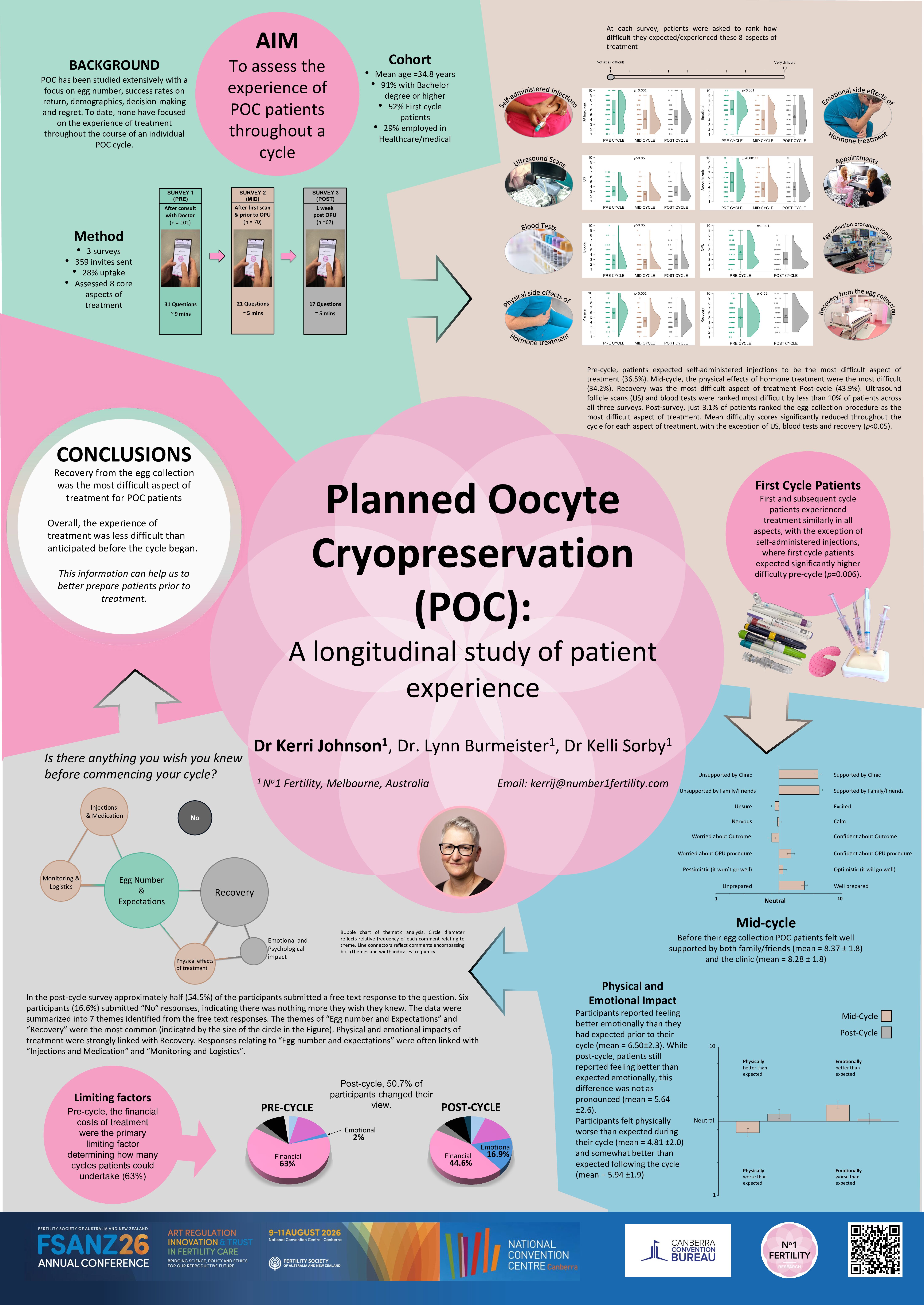
Title: Planned oocyte cryopreservation (POC): A longitudinal study of patient experience
Presented at: Fertility Society of Australia and New Zealand 2026
Presented by: Kerri Johnson
This study was a longitudinal survey based study looking at the experiences of a cohort of patients undergoing Planned Oocyte Cryopreservation.
We found that First and Subsequent cycle patients experienced treatment similarly in all aspects, with the exception of self-administered injections, where first cycle patients expected significantly higher difficulty pre-cycle. Recovery from the egg collection was the most difficult aspect of treatment for POC patients
Overall, the experience of treatment was less difficult than anticipated before the cycle began.
This information can help us to better prepare patients prior to treatment.

Title: It could make all the difference: PGT-M with repeat sizing for fragile X syndrome
Presented at: Fertility Society of Australia and New Zealand 2025
Presented by: Alice Weeks
This study presents a retrospective cohort study on the clinical utility of PGT-M with triplet repeat sizing for Fragile X Syndrome (FXS) in IVF patients who are premutation carriers of the FMR1 gene.
Including triplet repeat sizing in PGT-M for FMR1 premutation carriers significantly increases transferable (unaffected) embryos using own eggs, offering hope for biological children while avoiding full mutation FXS. This advance addresses the key question of whether premutations expand to full mutations in embryos.
The study highlights improved reproductive options for FXS premutation carriers through precise genetic testing.

Title: Arrest or just A Rest? An investigation of transient arrests in embryonic development
Presented at: Fertility Society of Australia and New Zealand 2025
Presented by: Jamie Sturgess
This retrospective study analysed timelapse footage from 47,823 embryos cultured between January 2019 and June 2024 to investigate transient arrest in embryos (TAE)—periods of at least 24 hours without cell division despite prior normal fertilisation.
Embryos experiencing transient mitotic arrest can still develop into utilizable blastocysts capable of producing live births, particularly when euploid. However, TAE is associated with poorer overall clinical outcomes. The study led to clinic protocol changes, including increased overall embryo yield. This is noted as the first study using timelapse imaging specifically to characterize transient embryonic arrests.

Title: The efficacy of transferring a frozen embryo during a fresh cycle
Presented at: Fertility Society of Australia and New Zealand 2025
Presented by: Brianna Dodd
This case-control study compared outcomes of frozen embryo transfers (FETs) performed during a fresh IVF cycle (n=72) versus standalone FET cycles (n=144) in 216 matched patients from January 2018 to April 2024. Patients were matched for age, BMI, cycle number, embryo grade, and ploidy status.
We found performing a frozen embryo transfer during a fresh IVF cycle is associated with significantly lower clinical pregnancy and live birth rates compared to standalone FETs. These insights can improve patient counseling and expectation management regarding the timing of frozen embryo transfers.

Title: Prenatal genetic testing uptake following the transfer of a PGT tested or untested embryo in Victorian IVF patients
Presented at: Human Genetics Society of Australia 2025
Presented by: Kayla Nowrojee
This retrospective study analyzed 434 IVF patients at No.1 Fertility (March 2024–January 2025) who achieved pregnancy following embryo transfer, stratified by embryo PGT status: Untested/No result (62.9%, n=273), PGT-A (41.2%, n=179), PGT-A-Mosaic (1.6%, n=7), PGT-SR (0.7%, n=3), and PGT-M (3.7%, n=16).
We found the uptake of prenatal genetic testing (particularly NIPT) remains very high regardless of whether the transferred embryo was PGT-tested or untested. Genetic counselling appears to play an important role in influencing decisions, especially in complex cases like mosaic embryos. Ongoing prospective data collection and qualitative exploration will further clarify decision-making pathways in IVF treatment.

Title: Efficacy of forced gassing in emergencies for IVF laboratories
Presented at: Scientists in Reproductive Technology 2025
Presented by: Shelley Zhang
This study investigated practical methods for rapidly equilibrating IVF culture media with CO₂ in emergency scenarios when immediate equilibrated media is unavailable, focusing on “forced gassing” techniques to lower media pH effectively.
We found direct cannula mixing is difficult to control (especially with pure CO₂) and labor-intensive with pre-mixed gas. The most practical and consistent emergency approach is administering 1 cm³ of 100% CO₂ via syringe, providing a reliable method for IVF laboratories to rapidly equilibrate media during gas supply disruptions.

Title: AI-based embryo assessment: What do embryologists think?
Presented at: European Society of Human Reproduction and Embryology 2025
Presented by: Kerri Johnson
This retrospective study evaluated two independent commercial AI systems for blastocyst viability assessment—Life Whisperer (LW) by Presagen and Intelligent Data Analysis (iDA) by Vitrolife—in a large clinical IVF laboratory. All 806 single embryo transfers (from blastocyst-stage embryos cultured in 2020) were independently scored by both AI tools and compared against clinical pregnancy outcomes (gestational sac) and pregnancy loss.
We found AI-based embryo assessment tools can aid embryologists in reducing inter-observer variability and improving embryo selection. The iDA system demonstrated stronger predictive performance for both implantation and reducing pregnancy loss. More effective AI ranking may decrease the number of cycles required to achieve pregnancy and lower pregnancy loss rates, particularly benefiting patients with multiple embryos available for transfer.

Title: Zymot or ZyNOT? Comparison of Zymot sperm preparation with conventional swim-up technique
Presented at: Asia Pacific Initiative on Reproduction 2025
Awarded Best Poster Presentation
Presented by: Casey Dean
This sibling oocyte study compared sperm preparation methods in 76 ICSI cycles, splitting semen samples between conventional Swim-Up (SU) and ZyMōt Multi Sperm Separation Device (Z).
We found the ZyMōt Multi Sperm Separation Device is easier to use and requires little to no prior experience compared to conventional Swim-Up. While it yields higher post-preparation sperm concentrations, no differences were observed in motility, HA binding, fertilisation, embryo development, euploidy, or clinical pregnancy rates. The study found no direct clinical benefit of ZyMōt over Swim-Up in relation to patient outcomes.

Title: Genetic counselling in IVF where are we now
Presented at: Human Genetics Society of Australia 2024
Presented by: Cheryl Tse
This retrospective review analysed patient records, clinic policies, and ART legislation at No.1 Fertility to outline the evolving role of genetic counsellors in IVF.
Genetic counselling in IVF has dynamically evolved, integrating advanced genomic technologies with proactive interventions to enhance patient outcomes and support informed reproductive decision-making.

Title: The hidden cost of reproductive genetic carrier screening for IVF patients
Presented at: Fertility Society of Australia and New Zealand 2024
Presented by: Cheryl Tse
This retrospective analysis (2019–2023, n=168 PGT-M cases) examined the impact of reproductive genetic carrier screening (RGCS) on referrals for preimplantation genetic testing for monogenic disorders (PGT-M) at No.1 Fertility, using Fragile X Syndrome as an example of broader implications.
RGCS profoundly influences IVF patients’ fertility journeys by uncovering genetic risks beyond the scope of traditional PGT-M. The rising trend in RGCS-linked PGT-M referrals highlights its growing importance in fertility care and informed decision-making.

Title: The role of genetic counselling for sex-selection with IVF in Victoria
Presented at: Fertility Society of Australia and New Zealand 2024
Presented by: Cheryl Tse
This retrospective audit (2019–2024) reviewed 26 applications for medically indicated sex selection (MISS) at No.1 Fertility, facilitated through genetic counselling and reviewed by the Patient Review Panel (PRP) under the Victorian Assisted Reproductive Treatment Authority (VARTA).
We found genetic counselling is essential for ethically implementing sex selection in IVF within Victoria’s strict regulatory framework (ART Act 2008). The study emphasizes challenges for counsellors and patients, highlighting the need for clear communication and robust support to align with ethical standards and legal requirements.

Title: The Compassionate Freeze: A study on embryologists’ decision making in utilising poor quality blastocysts for poor prognosis patients
Presented at: Fertility Society of Australia and New Zealand 2024
Presented by: Justine Gabriel
Genetic counselling is essential for ethically implementing sex selection in IVF within Victoria’s strict regulatory framework (ART Act 2008). The study emphasizes challenges for counsellors and patients, highlighting the need for clear communication and robust support to align with ethical standards and legal requirements.

Title: Telophase Tales – Classifying and evaluating the clinical competency of telophase-spindle oocytes
Presented at: Fertility Society of Australia and New Zealand 2024
Presented by: Phoebe Evans
This retrospective analysis examined 9,345 oocytes allocated to ICSI, using polarized light microscopy to identify spindle position prior to injection, with timelapse incubation for culture.
Telophase-spindle oocytes demonstrate significantly reduced embryological competence, exacerbated by delayed maturity. Routine spindle visualisation could prevent misclassification of many such oocytes as standard MII, enabling better patient counselling and expectation management.

Title: From here to fertility: preconception genetic testing for the infertile couple
Presented at: Preimplantation Genetic Diagnosis International Society 2024
Awarded Best Oral Presentation
Presented by: Alice Weeks
This retrospective cohort study (2018–2023, n=293) at No.1 Fertility (Melbourne, Australia) examined referrals for preimplantation genetic testing for structural rearrangements (PGT-SR) and monogenic disorders (PGT-M) to assess the value of baseline karyotyping and reproductive genetic carrier screening in infertile couples.
Karyotype analysis and genetic carrier screening are valuable preconception genetic testing options for infertile couples. Results from these tests can dramatically alter reproductive pathways by identifying additional or alternate preimplantation genetic testing options. These tests may offer a probable cause for infertility, providing closure and enabling identification of additional risks for patients.

Title: Clinical viability of oocytes with micronuclei at fertilization
Presented at: European Society of Human Reproduction and Embryology 2024
Presented by: Shalini Rajakaruna
This retrospective cohort analysis (January 2022–December 2023, n=15,229) examined embryos cultured in EmbryoScope+ to assess the impact of micronuclei (small satellite pronuclear structures) observed at fertilisation on embryo potential.

Title: Embryo Rescue: Practical Considerations and Implementation in a clinical laboratory
Presented at: Asia Pacific Initiative on Reproduction 2024
Presented by: Tania Tzelepis
This study details the implementation of PGT-Complete™ (PGT-C) technology at No.1 Fertility (Melbourne, Australia) to “rescue” embryos previously classified as abnormally fertilised due to displaying a single pronucleus (1PN) at fertilisation check.
1PN embryos have reduced developmental potential compared to 2PN but can result in live births. Successful implementation required extensive planning, staff training, clear patient communication, and cross-departmental coordination. Preliminary results support attempting to “rescue” previously unutilised 1PN embryos, particularly benefiting poor-prognosis patients, oncology-related fertility preservation, or donor arrangements. Clear instructions, thorough training, ongoing monitoring, and transparent patient communication are essential to overcome challenges.

Title: A new perspective on the age-old dilemma of fresh versus frozen: A comparison of outcomes for patients using their own fresh and frozen oocytes in the same cycle
Presented at: American Society for Reproductive Medicine 2023
Presented by: Shirley Zhang
This retrospective study (April 2018–June 2022) compared embryological and clinical outcomes from fresh versus vitrified/warmed autologous oocytes used in the same IVF cycle (63 cycles, 540 fresh and 677 vitrified oocytes, 308 embryos transferred/frozen).
Vitrified oocytes yield equivalent fertilisation and clinical pregnancy rates to fresh oocytes, but lower utilisation rates. Embryos from vitrified oocytes exhibit delayed development (mainly during cleavage stage), but this is unlikely due to spindle re-formation post-warming. This delayed morphokinetic development should be considered when assessing embryos derived from vitrified oocytes.

Title: Embryo Thaw and Biopsy – Data to Guide Patient Decision Making
Presented at: Asia Pacific Initiative on Reproduction 2023
Presented by: Vivian Leung
This retrospective study (2020–2023) evaluated the feasibility and outcomes of thawing cryopreserved blastocysts for trophectoderm biopsy in 108 embryos divided into three groups:
(A) Never intended to biopsy pre-freeze (n=42),
(B) Biopsy intended but not performed (untested, planned for PGT; n=32),
(C) Biopsy performed but no result returned (n=34).
Thawing and biopsying cryopreserved embryos is clinically feasible and can yield viable, euploid embryos suitable for transfer. Outcomes vary significantly by prior embryo status: untested embryos intended for PGT have lower euploidy and biopsy success, whereas re-biopsying embryos with prior failed testing shows high survival and success rates.

Title: Artificial Intelligence is Equally Capable of Predicting Viability of Embryos Created from Vitrified Oocytes, Despite Observed Differences in Morphokinetic Behaviour.
Presented at: Asia Pacific Initiative on Reproduction 2023
Presented by: Gabriella Pereira
This study assessed the performance of an AI embryo assessment tool (iDA by Vitrolife) in predicting clinical pregnancy for embryos derived from vitrified/warmed oocytes (VO) compared to fresh oocytes, using data from 186 VO cycles (1,577 vitrified oocytes) and a control of 43,957 fresh oocytes.
AI technology (iDA) predicts embryo viability and clinical pregnancy equally well for embryos from fresh or vitrified oocytes, despite the significant morphokinetic delays observed in vitrified oocyte-derived embryos.

Title: A Comprehensive Analysis of the Cells Originating From Tripolar Mitosis In The Preimplantation Embryo
Presented at: Asia Pacific Initiative on Reproduction 2023
Presented by: Tracey King
This retrospective analysis of 14,450 embryos cultured in EmbryoScope+ examined tripolar mitosis (TM) events—aberrant divisions producing three daughter cells—classified by mitotic cycle: Mitosis 1 (TM1, n=118), Mitosis 2 (TM2, n=206), Mitosis 3 (TM3, n=98), or multiple (MTM, n=26). Incidence of TM embryos was 3.1% (n=448).
TM1, TM2, and MTM embryos exhibit significantly reduced developmental potential, primarily due to cell exclusion of TM daughter cells. TM3 does not appear detrimental. Despite no impact on euploidy, TM embryos overall demonstrate lower implantation potential and live birth rates.

Title: Impact of preconception reproductive genetic carrier screening on PGT applications in Australia
Presented at: Preimplantation Genetic Diagnosis International Society 2023
Presented by: Cheryl Tse

Title: The Revolving Door- What can it teach us? Utilising transport service as a quality measure.
Presented at: Scientists in Reproductive Technology 2023
Presented by: Shelley Zhang
This retrospective analysis (2018–2021) reviewed 722 gamete and embryo transport requests at No.1 Fertility to evaluate transport data as a quality measure for service delivery and its role in patient counselling.
Transport service feedback is a valuable indicator of service quality. Patients can be reassured that gamete/embryo transportation has minimal impact on survival rates. Tracking shifting trends in patient decision-making (e.g., reasons for import/export) can drive service improvements, enhance patient retention, and offer broader insights into the ART landscape.

Title: Factors influencing patients’ decisions to transfer, store or discard embryos with mosaic PGT-A results
Presented at: Human Genetics Society of Australia 2022
Presented by: Rachel Chatterton
This poster presents a qualitative study on factors influencing IVF patients’ decisions about embryos with mosaic preimplantation genetic testing for aneuploidy (PGT-A) results (embryos containing mixed normal and abnormal cell lines).
Patients’ decisions are shaped by unique lived experiences and perceptions. Findings can guide genetic counselors in discussing key factors to support informed choices about mosaic embryos.
The study highlights the emotional complexity and need for better counseling amid PGT-A uncertainties.

Title: Comparing the efficacy of two commercially available AI-based embryo assessment tools in a large clinical laboratory
Presented at: European Society of Human Reproduction and Embryology 2022
Presented by: Daniela Iacobelli

Title: Comparing the efficacy of two commercially available AI-based embryo assessment tools in a large clinical laboratory
Presented at: European Society of Human Reproduction and Embryology 2022
Presented by: Daniela Iacobelli
Weight-based monitoring is feasible and superior for timely detection of tank failure, allowing safe relocation of material. Combined with infrared camera for vacuum failure detection, it adds security layers, reduces false alarms, and improves staff well-being (better sleep).
The system enhances cryogenic storage safety in IVF labs by focusing on actual risk (nitrogen loss/vacuum failure) rather than temperature alone.

Title: pHantastic Embryos and Where to Find Them: Can A Real-Time pH Monitoring System Represent the pH Environment of Culture Media?
Presented at: Fertility Society of Australia and New Zealand 2022
Presented by: Casey Dean
This study evaluates the SignipHy real-time pH monitoring system as a non-invasive tool for tracking pH in embryo culture media within IVF incubators.
SignipHy provides a viable, real-time representation of dynamic pH in culture media under multiple conditions, though it slightly underestimates the rate of change compared to direct dish measurements. It supports non-invasive monitoring to optimise embryo culture environments.
The study validates SignipHy as a useful tool for reducing environmental stress on embryos through continuous pH oversight.

Title: The Complexity Around Mosaic Embryo Decision Making- A Genetic Counselling Perspective
Presented at: Fertility Society of Australia and New Zealand 2022
Presented by: Maddie Teed
This study provides a genetic counseling perspective on the complexities of decision-making for patients considering transfer of mosaic embryos identified via PGT-A.
Mosaic embryo decision-making is highly complex, personal, and impacted by lived experience and fertility journey. Genetic counselors should focus on empathy and clear information delivery. Findings support developing a counseling guide on key discussion factors; further psychosocial research is needed.
The study underscores the need for tailored, empathetic genetic counseling to navigate uncertainty and emotional challenges in mosaic embryo decisions.

Title: Improving the accuracy of constant temperature monitoring of open-air stereo stages
Presented at: Fertility Society of Australia and New Zealand 2022
Presented by: Justine Gabriel
This study investigates improving temperature monitoring accuracy on open-air warming stages used in IVF laboratories, where ambient air exposure can cause probe readings to deviate from actual culture media temperature.
Small (2mm) steel spheres best substitute for culture media, providing accurate constant temperature monitoring on open-air stages and comparable warming rates. This enables more reliable quality control without using actual media.
The study offers a practical solution to enhance temperature accuracy in IVF procedures involving open-air stages.

Title: “Thick and Viscous” or “Light and Easy”: An oil overlay comparison.
Presented at: Fertility Society of Australia and New Zealand 2022
Presented by: Kavya Gunasegaran
This study compares “heavy” (higher density/viscosity) versus standard oil overlays for embryo culture media in IVF, focusing on their impact on pH stability.
Higher density/viscosity (“heavy”) oil overlays better blunt CO₂ loss during dish handling outside incubators, maintaining more stable pH and creating a superior environment for embryo culture.
The study supports using heavier oils to minimise environmental stress on embryos during procedures.

Title: The Race to Equilibrate – Quantifying O2 Equilibration
Presented at: Fertility Society of Australia and New Zealand 2022
Presented by: Eve Glage
This study examines oxygen equilibration rates in embryo culture media for low-oxygen (hypoxic) IVF conditions, highlighting the rapid influx of atmospheric oxygen when dishes are handled outside incubators.
Oxygen diffuses significantly faster than CO₂, meaning embryos in low-oxygen culture are quickly exposed to high oxygen tension during routine dish handling outside incubators.
The study emphasizes minimizing atmospheric exposure time and considering oxygen levels during dish equilibration to maintain intended hypoxic benefits for embryo culture.

Title: Protecting Our Laboratory Air Quality Through a Natural Disaster
Presented at: Scientists in Reproductive Technology 2022
Presented by: Anna Tran
This study evaluates the effectiveness of IVF laboratory air handling systems in maintaining air quality during Australia’s severe 2019-2020 bushfire crisis, which caused hazardous particulate matter (PM) and volatile organic compound (VOC) levels.
Robust laboratory air handling systems (positive pressure + HEPA filtration) effectively maintained high air quality in the embryology lab throughout the bushfire crisis, despite extreme external PM/VOC fluctuations.
The study affirms the resilience of proper IVF lab filtration systems during natural disasters affecting air quality.

Title: Growing Lead Follicles Beyond 20mm Significantly Increases the Risk of Failed Fertilization with Conventional IVF
Presented at: Asia Pacific Initiative on Reproduction 2021
Presented by: Shalini Rajakaruna
This study presents a retrospective cohort study on the impact of lead follicle size at trigger on fertilization outcomes in conventional IVF.
Follicle diameter at trigger directly impacts conventional IVF fertilization outcomes. Growing lead follicles beyond 20 mm significantly increases the risk of failed fertilization (up to four-fold), highlighting a potential paradox in ovarian stimulation protocols aimed at maximizing oocyte yield.
The study suggests earlier triggering may improve fertilization rates in conventional IVF by avoiding post-mature oocytes.

Title: Don’t Judge a Book by its Multinucleation
Presented at: European Society of Human Reproduction and Embryology 2020
Presented by: Vassana Songkhunawej
This study presents a retrospective study evaluating the impact of multinucleation (visible multiple nuclei in blastomeres) on embryo development and IVF outcomes using time-lapse monitoring.
Multinucleation had no significant impact on implantation or ability to sustain a viable pregnancy to live birth. It should not be used as a exclusion criterion for embryo selection and is an inconsequential factor in assessing viability of utilisable blastocysts.
The study leverages time-lapse advantages to show multinucleation is often transient and not predictive of poor outcomes.

Title: ‘You Can’t Sit With Us’ – The misconception of the excluded cell
Presented at: Fertility Society of Australia 2019
Presented by: Tania Fernandez
This study presents a retrospective study using time-lapse imaging to investigate the impact of cell exclusion (extrusion/lysis of cells during embryo compaction/morula stage) on embryo development and IVF outcomes.
Excluded cells have no detrimental effect on embryo development, euploidy, or clinical outcomes. Their presence may indicate a self-correcting mechanism (potentially eliminating aneuploid cells during compaction), challenging the misconception that excluded cells negatively impact viability.

Title: Curse of The Broken Spindle – What becomes of an ill-fated oocyte?
Presented at: Scientists in Reproductive Technology 2019
Presented by: Anna Tran
This poster examines the impact of rare abnormal meiotic spindle presentations in oocytes on fertilization, embryo development, and IVF outcomes using polarized light microscopy.
The study highlights spindle anomalies as potential markers of oocyte competence, with not-anchored presenting a curious exception warranting further investigation.

Title: Filaments! What are they good for?! Maybe, something?
Presented at: Scientists in Reproductive Technology 2019,
Presented by: Casey Dean
This study describes a novel observation of transient string-like structures termed “filaments” appearing during the first mitotic cleavage division in human embryos, captured via time-lapse imaging (Embryoscope Plus).
Filaments at the 2-cell stage appear to “pull” fragments from the embryo, suggesting a type of fragmentation with lesser effect on pregnancy rates than non-filament fragmentation. Location of cell-zona anchor and cleavage furrow correlate with filament volume observed; may help discern fragmentation source.

Title: Zona Hatching on Day 3 Has No Detrimental Impact on Embryo Expansion
Presented at: Fertility Society of Australia 2018
Presented by: Kelli Sorby
This study evaluates the impact of day 3 laser-assisted hatching (LAH) on subsequent blastocyst expansion using time-lapse imaging and a novel 3D volume quantification method.
Day 3 LAH has no detrimental impact on blastocyst expansion. The technique provides a reliable, low-pulse method for assisted hatching and an effective way to quantify expansion in prematurely hatched embryos.
The study supports safe use of day 3 LAH without compromising post-hatching development.

Title: Compaction on Day 4 is a Strong Predictor of Embryo Utilisation and Valuable in Managing Patient Expectations
Presented at: Fertility Society of Australia 2018
Presented by: Ilona Rose
This study evaluates day 4 embryo compaction as a mid-cycle predictor of blastocyst utilization and patient expectation management in IVF.
Day 4 compaction assessment is a valuable tool for predicting blastocyst utilization, enabling realistic patient updates on cycle progress and potential outcomes with minimal lab investment.
The study supports routine day 4 compaction evaluation to enhance patient communication and experience.

Title: Does Oocyte Spindle Normalcy Impact IVF Outcomes
Presented at: Fertility Society of Australia 2018
Presented by: Kelli Sorby
This study investigates whether oocyte metaphase spindle normalcy (visualized via polarized light microscopy during ICSI) impacts fertilization, embryo utilization, and IVF outcomes.
Spindle normalcy at ICSI impacts fertilization and utilization rates. Patients with ≥1 abnormal spindle oocyte have lower overall rates than those with all normal, despite similar outcomes across the entire cohort. Identification allows better expectation management and informed future treatment discussions.
The study highlights spindle assessment as a useful, non-invasive prognostic tool in ICSI cycles.

Title: Revising Fertilisation Timing – Have We Been Sleeping on the Job?
Presented at: Fertility Society of Australia 2018
Presented by: Amy Clements
This study challenges the traditional timing of fertilization assessment (16-20 hpi) in IVF, using time-lapse imaging to reveal earlier pronuclear dynamics and flaws in surrogate markers.
Pronuclei appear and (critically) disappear earlier than traditionally assumed, risking up to ~7.5% of fertilized oocytes being incorrectly discarded in labs checking at 16-20 hpi. Surrogate measures (polar bodies, early cleavage) are unreliable. Recommend revising fertilization checks to no earlier than 14 hours and no later than 17 hours post-insemination to capture true fertilisation status.